
From Speeding to Slowing Down: What a Speed Awareness Course Can Teach Us About the Classroom
A National Speed Awareness Course might seem an unlikely place to explore neuroscience, behaviour and learning yet the experience offered surprisingly powerful insights for the classroom. By making concepts such as hazard prediction, emotional regulation and brain-body awareness explicit, the course revealed how decision-making is shaped by stress, emotion and environmental cues. These same principles are highly relevant to education, where children’s behaviour communicates vital information about safety, regulation and readiness to learn. This article reflects on how slowing down, reading behavioural signals and anticipating barriers can support safer roads, calmer classrooms and more connected relationships.

Long and Winding Road
Okay, bear with me… this will all make sense in a minute!
I’ll admit that joining a National Speed Awareness Course wasn’t exactly on my 2025 vision board. It came with a little embarrassment and a lot of unexpected insight.
From the moment the course began, I found myself thinking:
Neuroscience is showing up everywhere now — even in how we teach safe driving.
We weren’t just instructed to “slow down”. We were invited into the why behind the decision to speed.
Are you ready for this? The emotions, the brain-body signals, and the invisible risks we often overlook.
The Brain as a Prediction-Making Machine
By now, I am sure you will have heard me talk about the brain as a prediction-making machine. Well, one of the most powerful ideas running through the course was hazard prediction. Our brains are constantly scanning the environment, predicting what might happen next and asking a simple but vital question:
“Am I safe?”
The trainer explained that we don’t just react to hazards, we learn to predict them by noticing clues. These were grouped into three clear categories:
Behaviour clues – what people are doing (a pedestrian turning their back, a cyclist wobbling)
Design cues – what the road layout is telling us (bends, narrow lanes, junctions)
Environmental cues – what might be hidden or obscured (parked vehicles, weather, visual blocks)
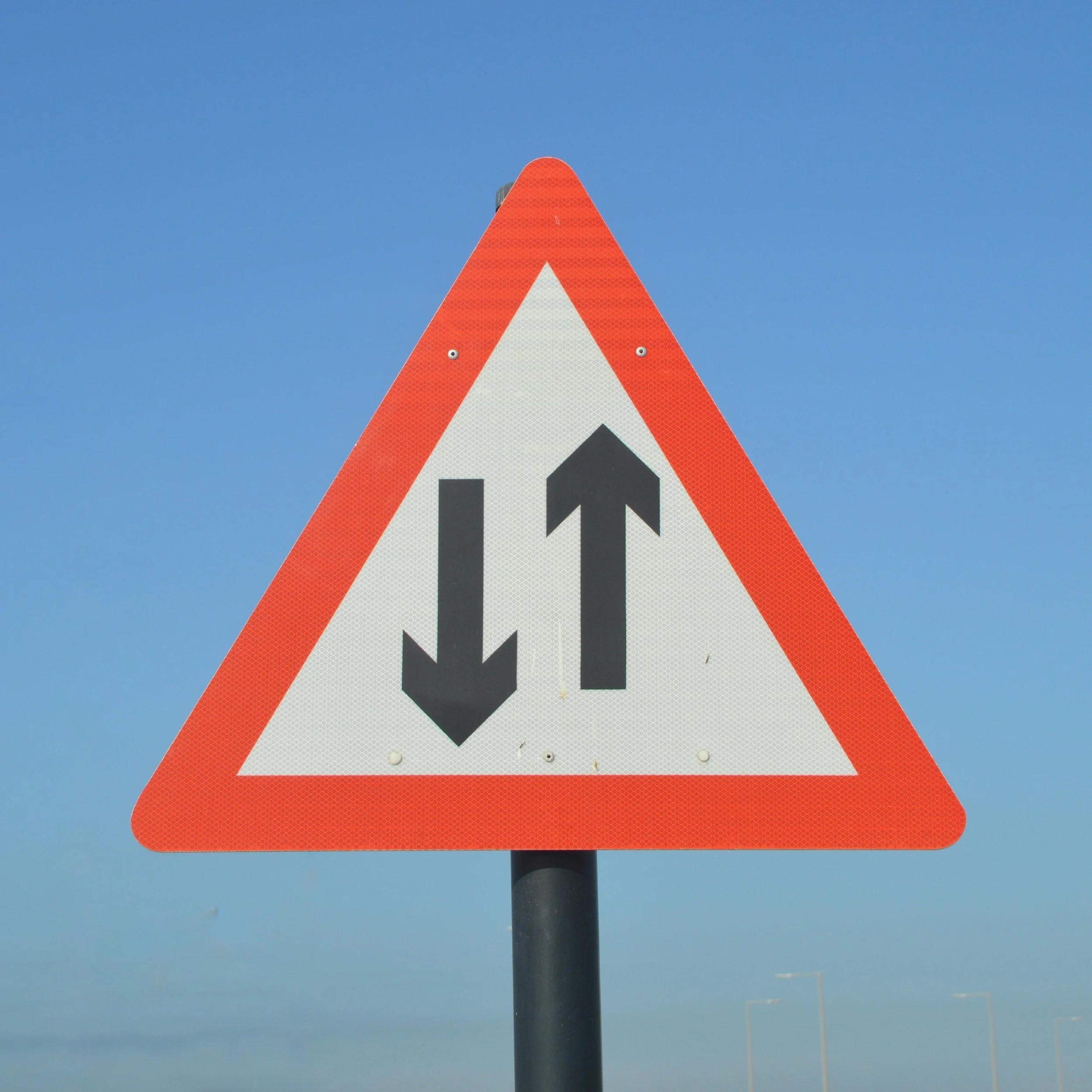
Both Directions Road Sign
He repeated a phrase that really stayed with me:
“Read the road — the road is talking to you.”
Can you see where I am going with this? Of course my brain networks were firing off making connections to the classroom (yes, I did pay attention to the instructor despite a little mind-wandering or ‘default mode network firing!’)
Immediately, I thought of children.
Children’s behaviour talks to us too.
Their movement, silence, resistance, energy or withdrawal are all forms of communication.
When we slow down enough to read those signals, we gain valuable information about what they might need next.
Hazard Prediction and Choosing a Safe Speed
Hazard prediction wasn’t only about spotting risks — it was about adjusting behaviour in advance, particularly when choosing a safe speed.
For example, a single-carriageway road may technically allow 60mph, but if there are:
narrow lanes
bends
cyclists
hidden junctions
…the safest speed may be much lower. The emphasis wasn’t on the legal limit, but on asking:
“What is the safest speed for this moment, given the most likely hazard?”
That question translates beautifully into education and parenting.
When we know a child well — their triggers, sensitivities and stress points — we can begin to predict the most likely barriers to participation in learning. We can adjust the pace of expectation before things escalate.
Just as on the road, prevention isn’t about control — it’s about anticipation and care.
HASTE: When Emotions Take the Wheel
Another key framework introduced to us, which made me fire on all cylinders…was the acronym HASTE:
Hurried
Angry
Stressed
Tired
Excited
In these states, the emotional brain takes over and the prefrontal cortex — responsible for reasoning, reflection and decision-making — goes partially offline. This is when we are more likely to take risks, including speeding. See what I mean! Neuroscience is EVERYWHERE!
The instructor made an important point:
“We could just teach you the rules. But rules sit in the cognitive ring.
Behaviour lives in the emotional ring.”
This literally, is the essence of my work…I don’t want to only speak to parents, carers and educators on a cognitive level, I want to speak to them at an emotional, embodied level. Same is true for driving instruction evidently!
All of this felt deeply familiar.
In classrooms and families, we often rely on rules and logic yet when a child (or adult) is dysregulated, those words simply can’t land. Regulation must come before reasoning.
Breathing, Awareness and Brain-Body Signals
If my excitement couldn’t be more contained, as part of the course, we were taught triangular breathing as a simple breathing technique to calm the nervous system in the moment.
Slow inhale.
Pause.
Longer exhale.
This wasn’t framed as mindfulness for mindfulness’ sake — it was presented as a neurological strategy to bring the thinking brain back online.
Even more powerful was the emphasis on awareness. Simply recognising heightened emotion — noticing tension, frustration or urgency — helps re-engage the prefrontal cortex.
One question stood out:
“If you’re feeling highly emotional, is it the right moment to get in the car?”
As parents and teachers, we don’t always have the option to step away — but even naming our internal state changes how we respond. Awareness creates choice. This is something I share with families and educators in my work with them - and in schools, with senior leaders, so we can create containers for educators to be able to step away when necessary for the brief moments that make the difference between de-escalation and escalation.
Behaviour Is Communication — Everywhere
What stayed with me most was how transferable all of this learning is.
Whether on the road or in a classroom:
Behaviour gives us clues
Environments shape responses
Emotions influence decisions
Prediction allows protection
The road talks to us.
Children talk to us.
Our bodies talk to us.
When we slow down enough to listen, we reduce risk, not just accidents, but ruptures in relationships and learning.
A Final Reflection
Despite the irony of how I ended up there, I left the Speed Awareness Course feeling genuinely encouraged. It showed how far we’ve come in recognising that behaviour doesn’t exist in isolation. It is shaped by brains, bodies, emotions and environments.
Speed — whether in driving, teaching or parenting — isn’t inherently bad.
But speed without awareness is risk.
When we slow down, read the signals, and predict rather than react, we create safer roads, calmer classrooms and more connected relationships.
And that feels like awareness worth building.
Disclaimer: I am not a road safety instructor so definitely apply caution to my observations from the Speed Awareness Course! I would not recommend that anyone speeds, but I would recommend this course!
